CBR Test: Get Reliable California Bearing Ratio Testing for Your UK Construction Project
When you are planning construction projects, you need accurate data on the soil beneath your site. A CBR test provides that certainty. Our California Bearing Ratio testing services deliver precise insight into bearing capacity, subgrade strength, and soil performance at the surface level.
By assessing subgrade soil, subgrade and subbase materials, and all-around soil strength, we help you design safer, more durable infrastructure.
Our testing supports informed foundation design, optimised pavement design, and compliance with UK standards for civil engineering purposes.
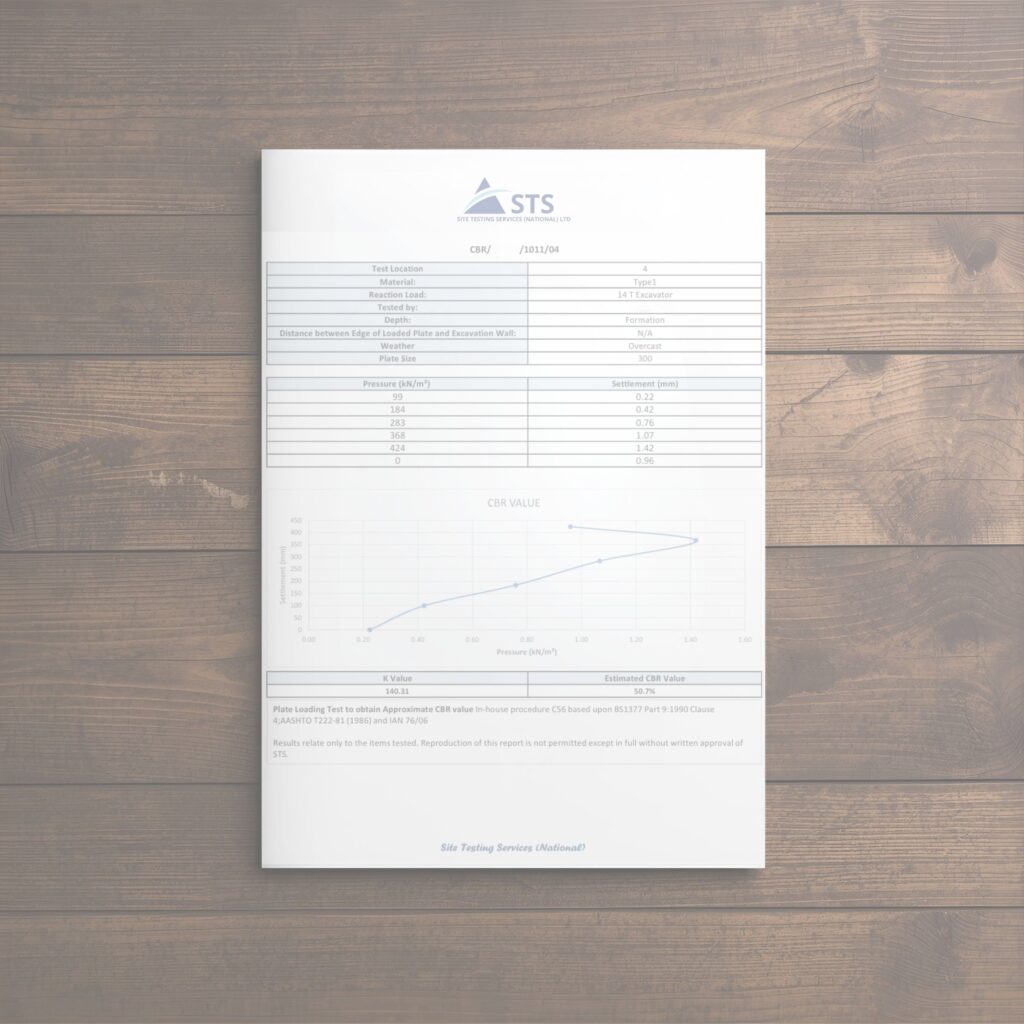
What is a CBR Test?
 The California Bearing Ratio (CBR) test is a widely accepted penetration test used to assess the mechanical strength and stiffness of soil. It was developed by the California State Highway Department in the 1930s and is now a cornerstone of global pavement and foundation design.
The CBR test procedure measures the pressure required for a standard circular piston to penetrate a prepared soil mass at a specific depth. Results are compared against a standard crushed rock material, which has a defined CBR of 100%.
This California bearing ratio test is described in BS 1377: Part 9: 1990. Soils for civil engineering purposes remain important for modern infrastructure delivery.
How a CBR Test Works
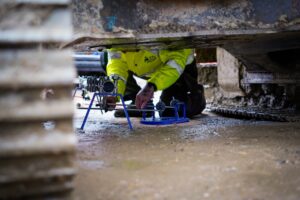
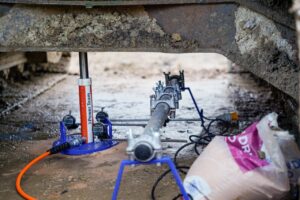
A CBR test is performed using a steel plate, typically a 300mm plate, pushed onto a prepared onsite location at a controlled rate. The force required, applied pressure, and measured pressure are recorded using calibrated dial gauges.
Testing may be carried out:
- In situ, using underneath a reaction load such as an excavator.
- In a laboratory under controlled conditions
- Using correlated methods such as the Dynamic Cone Penetrometer (DCP) or Plate Load Test (PLT)
In-Situ and Laboratory CBR Testing Methods
We provide flexible testing to suit site access, material type, and programme requirements.
In Situ CBR Test (Field Test)
An in situ test measures soil performance directly at the test location along the proposed construction centreline. A rigid plate and reaction load are used to simulate realistic loading conditions at the surface level.
This approach is ideal where seasonal moisture variations, ground variability, or programme speed are key considerations. Provisional results are often available the same day.
Laboratory CBR Testing
Laboratory testing allows precise control of moisture content, dry density, and specimen preparation. Soil samples are compacted to replicate site conditions and are often soaked for up to 96 hours to simulate worst-case conditions.
Lab testing is typically carried out on materials with a maximum particle size of 20mm and provides highly repeatable test results.
Where CBR Testing Is Used
CBR testing is critical for:
- Road construction and pavement foundations
- Subgrade and sub-base assessment
- Pavement foundations and flexible pavement design
- Airport runways and access roads
- Industrial hardstandings and car parks
- Foundation platforms for structures
Understanding physical properties, subgrade strength, and settlement behaviour, engineers can optimise layer thickness and material selection.
Our CBR Testing Process
Consultation & Planning
We’ll assess your site conditions, project scope, and any environmental factors to pick the right method, on-site or lab, to get the accurate California Bearing Ratio (CBR) values you need.
Sample Collection or On-Site Testing
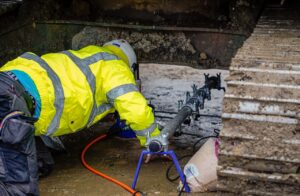
Our technicians go out on-site and either grab some representative soil samples or do some penetration tests using the standard test methods, the gears, load frames, and dial gauges to figure out the CBR values as accurately as possible.
Compaction & Analysis
Our team then takes those soil samples and gets them to the right dry density and water content. Then they compact them to make sure they’re just like they’d be out in the field. They measure how well they can resist the load at the right depths.
Reporting & Expert Advice
We take the results of our testing, the California Bearing Ratio, percentage force, load reading, moisture content, and all that, and turn them into actionable reports that actually give you something to work with.
Why CBR Testing Matters
Conducting a CBR test on your site is a key way to measure if what you choose to build on your soil will stay stable, or if it will fall apart over time. You can use the results of your CBR test to directly feed into your decisions around the cost, safety, and overall lifespan of your project.
Predicting Ground Deformations
After a road is laid, every vehicle applies stress to the ground underneath. With the results of our testing, you can properly predict and plan for how the soil will change over time due to increased stress. Soil with a low CBR value is prone to more deformities, including rutting and cracking over time.
Informs Ground Improvement Decisions
With the results of a CBR test, you can fully prepare and adapt for how the ground you are working on will behave throughout and after the construction process. This could include stabilising the soil with a cement or lime treatment, or completely replacing poor-quality soil for something that better fits the needs of your project.
Reduces Overall Risk
Ground conditions are one of the biggest uncertainties in construction, but working with the results of a CBR test will allow you to work based on facts, not guesses.
Why Choose Us?
Civil Engineering Expertise
Extensive experience across UK ground conditions and materials.
Nationwide Coverage
CBR testing services are available across the UK with rapid mobilisation.
Fast Turnaround
Field results within hours; laboratory testing within days.
Transparent Costs
Clear pricing for CBR testing, plate load, incremental plate load, and supporting investigations.
Standards-Led Approach
Fully compliant with BS1377, TRL guidance, and industry best practice.
Client-Focused Reporting
Practical interpretation that supports decision-making, not just compliance.
The Areas We Serve
We work to deliver high-quality CBR testing to construction projects nationally. From road and pavement construction to airport runways and car parks, we work collaboratively with you to deliver reliable CBR values and help you to make informed decisions for your project.
Contact our team today to see how we can help you.
Frequently Asked Questions
What does a CBR value actually tell me?
The CBR value provides a quantified measure of soil strength and stiffness. Higher values indicate stronger ground that can support heavier loads with reduced pavement thickness.
Can CBR tests be performed on-site?
Yes. In situ CBR tests provide realistic performance data under actual ground conditions using vehicle-mounted reaction loads.
Does moisture content affect CBR results?
Significantly. Higher moisture levels can reduce soil strength, which is why soaked testing is often used to assess worst-case performance.
What soil types are suitable for CBR testing?
CBR tests are typically carried out on soils with a maximum particle size of 20mm. Larger particles are usually assessed using plate-bearing methods.
Start with Confidence: Book Your CBR Test Today
 Get a better read on your project’s soil and make certain you’re getting roads, pavements, and foundations that are top-notch. We can give you the kind of reliable CBR testing and expert geotechnical advice that the pros and regulators trust. Whether you’re looking for a lab or an in-the-field test.
Call us today to get your quote.
